Why is it that it is predominantly in European countries where we frequently hear diversity being celebrated and embraced as a significant strength? We rarely, if ever, claim that China should welcome a greater number of non-Chinese individuals or suggest that the vast continent of Africa requires an influx of people who are not native Africans. Similarly, there is little to no advocacy for Japan to increase its population of non-Japanese residents. This distinct perspective on diversity seems to be largely unique to Europe, where multiculturalism is often viewed as a valuable asset rather than a challenge.
The cultures of these places play an absolutely critical role in identifying who the people are and what they truly stand for, shaping their collective identity and sense of belonging. These cultures are deeply reflected and embodied by the values, customs, and traditions upheld by the majority founding population that has lived there for generations. But what would Vietnam look like if the majority of its people were mostly foreigners, coming from different backgrounds and cultures? Would Vietnam still retain its rich and unique Vietnamese traditions in such a scenario, or would those traditions gradually fade away? And if not, then why wouldn’t the new majority promote and celebrate their own distinct cultural heritage instead? These questions highlight the complex relationship between population demographics and cultural identity.
There is no politically motivated movement aimed at “diversifying” non-Western countries in a similar way. So why, then, do we in Western societies feel such a strong pressure or desire to encourage mass immigration? Isn’t our own culture and heritage at risk of being diluted or lost in the process? It is undeniable that, in today’s world, migrants often bring with them and actively maintain their own traditions and customs even while living in a foreign land, which can lead to a rich but complex cultural landscape.
Isn’t a civilization fundamentally defined by its people, their customs, and long-standing traditions, and if those original people are no longer the majority within that society, doesn’t this put their unique cultural identity at serious risk of fading away or even complete extinction? If the United States were to become a nation where 50% or more of the population is foreign-born or from different cultural backgrounds, wouldn’t this significant demographic shift pose a genuine threat to the preservation and continuation of its traditional Western civilization and the values it has long upheld?
These are valid questions that deserve an answer, but for some reason they are surrounded by negative connotations.
America
America was originally founded by Europeans who established a Western nation intentionally designed to embody and reflect their own laws, values, cultural traditions, and customs. Over time, they brought in and welcomed millions of people from various other Western populations, encouraging these newcomers to settle and integrate into the country. These diverse groups gradually assimilated into the land, contributing to the development and growth of the nation while maintaining the foundational Western principles.
History gives us the most tangible proof when determining the cause of an old civilization’s demise or the plans to dismantle an existing empire. Understanding the present often necessitates a thorough understanding of the past, which may explain why so many young Americans are denied such studies in school.
One can study civilizations and empires throughout history that have disappeared after being incapable of sustaining the original population.
Egypt, early evidence of cultural catastrophe
Egypt was one of the first and most well-known civilizations/empires, and evidence of their superiority can still be seen in the heated desert sands today, such as the enormous pyramids and the Sphinx of Giza.
The Sphinx and the Great Pyramids were built in approximately 2500 BC, a gigantic endeavor spearheaded by Pharaoh Cheops (Khufu), who is now regarded as one of the most well-known pharaohs of all time.
Khufu, like most of the other pharaohs who ruled early Egypt’s most magnificent kingdoms, was of Nordic heritage and white. It wasn’t until the second half of the third dynasty that Semitic and non-white populations gained a strong foothold in Egypt, and original Europeans began an irreversible process of replacement. Was this one of the oldest known genocides against a great civilization?
Egypt had always maintained a homogeneous civilization in terms of rulers and population, and it wasn’t until they were overrun by the Hyksos, a Semitic race from the north, around 1785, that non-Egyptian blood was introduced in significant numbers.
The Hyksos had a technological advantage over the Egyptians; at the time, the Semitic tribe was equipped with chariots, horses, and iron weapons, giving them the ability to defeat even the most fearsome Nordic fighter. However, after 200 years of slavery, the Egyptians mastered this military development and punished the Hyksos, reclaiming control once again.
Unfortunately, the continued use of Black and Semitic slave labor, combined with the subjugation by the Hyksos, opened the door to cultural diversity, which would never be totally closed.
The turmoil and ruin caused by inundating a prosperous society with people from other cultures is usually irreparable. Although a course correction was too late, the ancient Egyptians were not entirely unaware of this fundamental life lesson.
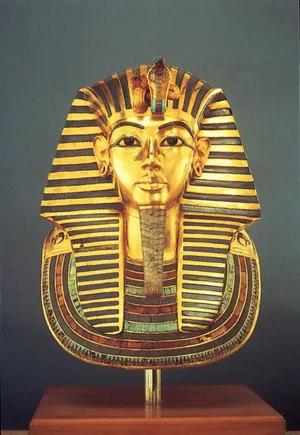
As late as 1350 BC, Tutankhamen (King Tut), the boy king, realized the difference in race, as is evidenced by some of the artifacts in his tomb. On the footrest of one of Tut’s thrones were nine Black and Semitic prisoners, Egypt’s arch-adversaries, bound by chains, meaning that his enemies were under his foot.
Another remarkable treasure in Tutankhamun’s tomb was his walking stick, which had the handle engraved with images of his black and Semite foes linked together; when he used his royal walking stick, he held his enemies in his hands.
There was more acknowledgment of his racial enemies in Tut’s burial. Another striking sentiment was Tut’s iconic wooden chest; it laid out a scene of the young king cruising around in a horse-drawn chariot, mowing down his Black and Semitic enemies.
After the 18-year-old king unexpectedly left the living world, subsequent rulers attempted to defuse the genocidal time bomb but were unsuccessful. Egypt, having been demographically weakened by the Hyksos invasion and absorbing a greater number of Nubians through conquest, was now confronted with multiple new and deadly opponents; the job was overwhelming.
The original whites were an expiring commodity, and with their disappearance went unbridled ingenuity and technological accomplishment; never again would Egypt produce such marvels as the great pyramids.
Simply look to Egypt, which I covered in this article, Rome, and classical Greece; these are great examples of the extinction of masterful civilizations that ended after the founding race was overwhelmed by one or more varying races.